A leading global producer and supplier of rare metals relies on corrosion-resistant chemical processing equipment for its extraction and purification processes, which include acid digestion, solvent extraction, and precipitation. The company had previously worked with RMB Products, utilizing their rotational lining technology for smaller components such as stripping columns. Through a distributor connection, they learned that RMB’s technology could also be applied to larger vessels.
Challenge: Complex tank repair tests limits of rotational lining capabilities
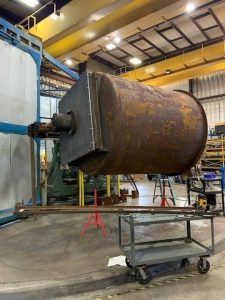
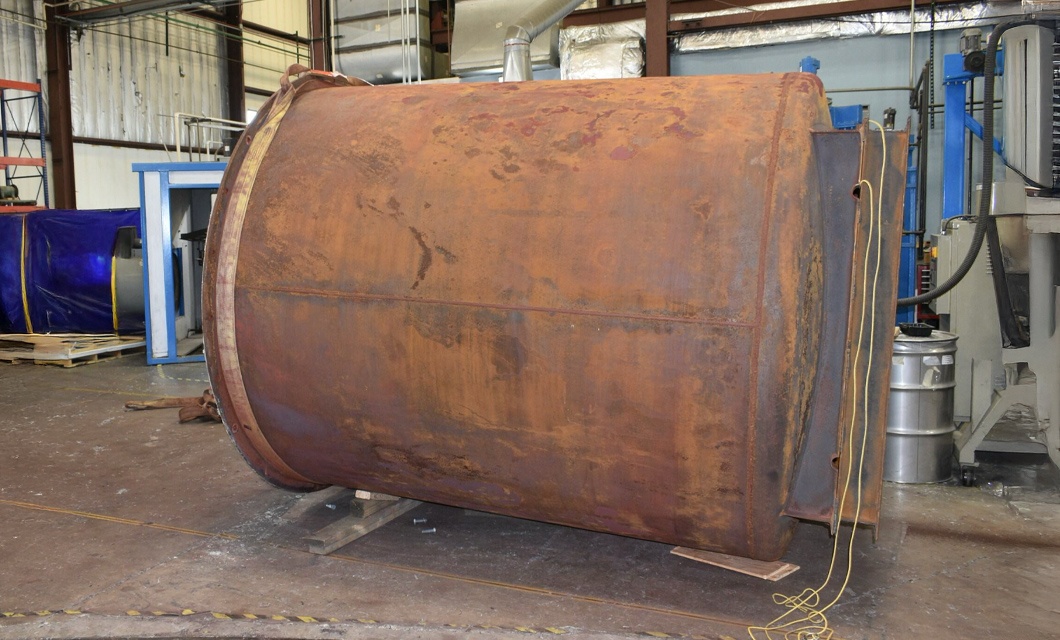
The company faced a critical equipment failure when a steel heating tank experienced a mechanical epoxy adhesion failure. The existing polymer liner (installed as a welded sheet) delaminated from the tank’s metal substrate, compromising the tank’s integrity and threatening production.
Several factors complicated the repair process:
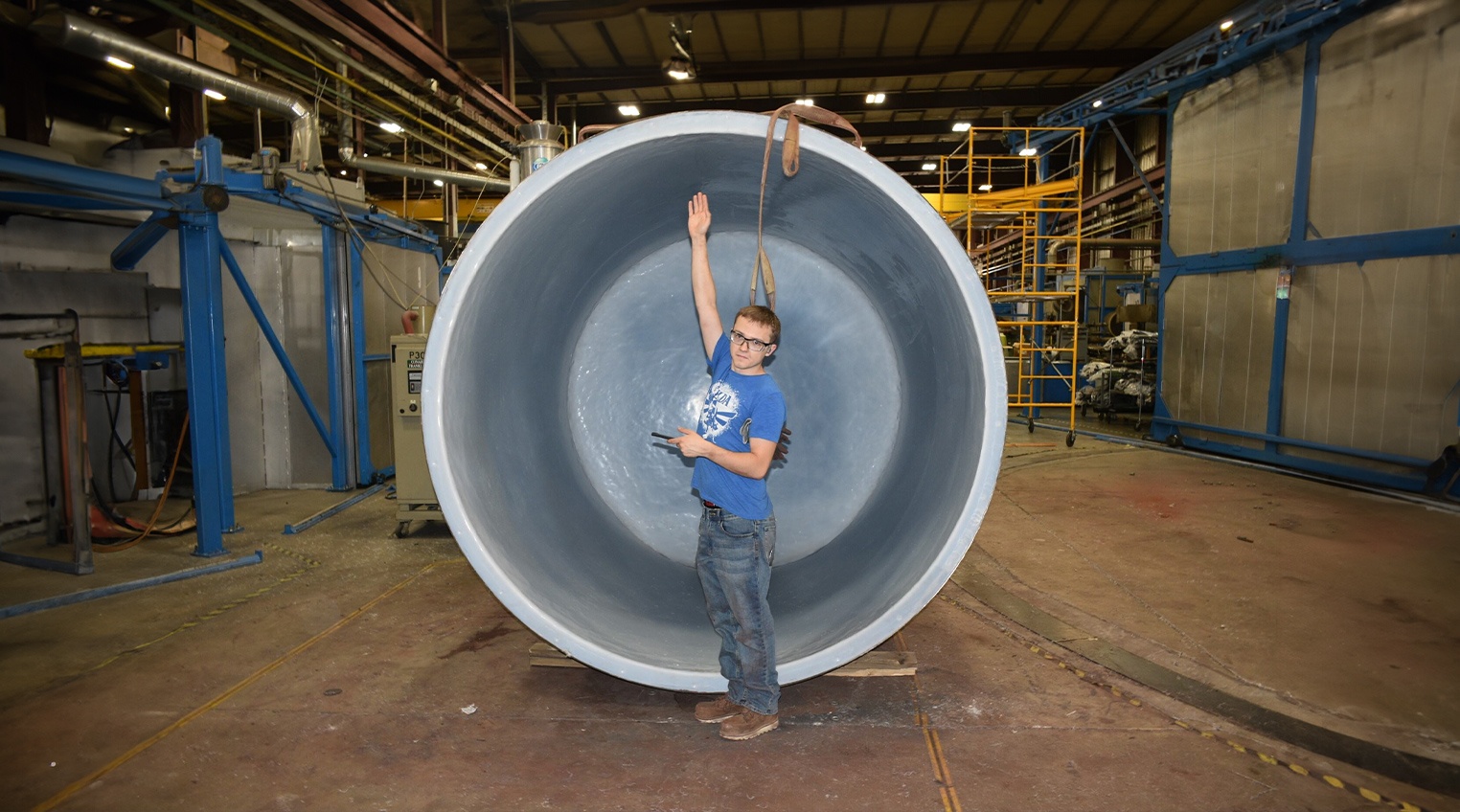
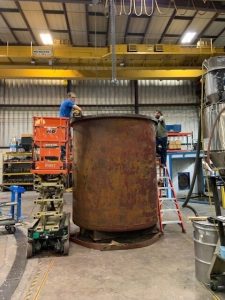
- The tank’s size (approximately 10 feet tall) pushed the limits of RMB’s rotational lining equipment capacity.
- The lack of traditional lifting points or lugs made movement and positioning during the lining process difficult.
- The repair needed to be completed within a tight timeline.
- The application required a high-performance fluoropolymer lining capable of withstanding harsh chemical environments and wide-ranging temperature fluctuations.
Solution: Seamless ETFE rotational lining fully bonds to eliminate delamination risks
Rotational lining, or rotolining, is a coating process that involves placing plastic resin powder within an industrial component, such as a pipe, tank, or vessel, and inserting it into a large oven. As the oven heats up, the component slowly rotates on two axes. The combination of movement and heat melts the resin and distributes it evenly throughout the inside surface of the component. As the mold rotates, the oven melts the resin to coat the component (e.g., pipe or tank) inside the oven. The size of the oven dictates the maximum size of the components that can undergo the rotational lining process.
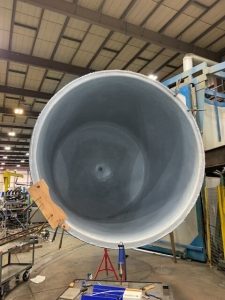
RMB proposed lining the tank with a seamless, monolithic layer of ethylene tetrafluoroethylene (ETFE) to replace the failed sheet liner. This solution provided several benefits over the previous method, including:
- Produces a single, continuous layer of material, eliminating potential weak points.
- Creates a mechanical bond between the ETFE and the metal substrate.
- Moves with the metal substrate during thermal cycling, reducing stress on the lining material.
- Reduces the risk of delamination compared to adhesive-bonded sheet linings.
- Allows for precise control over the liner thickness and properties.
Process: Meticulous preparation ensures project quality
RMB takes a comprehensive approach to relining tanks, starting with meticulous preparation. The process begins with removing the existing liner through a specialized burnout method, which effectively eliminates the liner and any residual contaminants or mill scale from the metal surface. Following the burnout, a thorough inspection is conducted to assess the integrity of the tank’s structure and welds. The interior surface is first prepared using grit blasting and then rinsed with a solvent to create a clean bonding surface.
Given the tank’s size, RMB used specialized equipment and proprietary techniques to load hundreds of pounds of ETFE powder into the vessel. The team carefully calculated the powder quantity required for even coverage and consistent thickness throughout the tank.
Post-processing included custom trimming techniques developed to accommodate the tank’s large size and unique geometry. Finally, the team conducted a final inspection to verify the lining’s integrity and adherence to specifications.
Overcoming challenges: Custom rigging and resin quantity solved special challenges
RMB employed several innovative approaches to address the project’s unique challenge:
- Size limitations: RMB utilized its largest rotational lining equipment and optimized the process parameters to accommodate the tank’s dimensions.
- Material handling: In the absence of traditional lifting points such as flanges or lugs, RMB developed custom rigging solutions to maneuver the tank safely throughout the relining process.
- Time constraints: RMB implemented efficient scheduling and process optimization to meet the expedited shipping request, completing the project within the last two weeks of the customer’s fiscal year.
- Material application: To manage the large quantity of ETFE powder required, RMB employed a combination of automated hoppers and manual loading techniques.
- Curing process: The timing was crucial for maintaining the equipment’s elevated temperature and facilitating the rotational lining process, necessitating precise coordination between the loading and lining steps.
Results and benefits: Rotational lining eliminates weak points common to welded seams
The rotational lining solution offered several significant advantages over the welded sheet lining previously employed for the heating tank. The seamless, monolithic ETFE lining eliminated the weak points associated with welded seams, reducing the risk of future failures.
ETFE’s excellent chemical resistance properties supply long-term protection against the harsh processing environments the tank encounters. The mechanical bond between the lining and substrate enables better management of thermal expansion, reducing stress on the lining during temperature fluctuations.
The superior bonding and seamless construction of the rotational lining are expected to significantly extend the tank’s service life compared to the previous sheet lining solution. Additionally, the rotational lining process allowed for better control over the lining thickness and properties, optimizing performance for the customer’s designated application.
One challenge of sheet lining is the difference in the coefficient of thermal expansion between steel and polymer lining, which can jeopardize the mechanical or adhesive bond. As the materials heat and cool repeatedly, this difference can weaken the bond, as one side expands more than the other. In contrast, rotational lining helps counter the effects of thermal expansion because it is bonded and moves with the metal, minimizing any localized relative motion.
Conclusion: Rotational lining provides a durable, reliable solution
There are scenarios within chemical processing where both welded sheets and rotationally lined tanks or pipes are applicable. This case study illustrates the advantages of rotational lining technology for chemical processing equipment in sizes larger than many customers anticipate. In this instance, the customer replaced a failed sheet lining with a seamless, rotationally lined ETFE solution. RMB successfully addressed the customer’s immediate needs while providing a durable, reliable solution for long-term use.
The project highlights the importance of considering alternative lining technologies, even for larger vessels traditionally lined with sheet materials. Companies supplying chemicals to semiconductor fabs, general chemical processors, mineral processors, and waste/wastewater treatment facilities should view rotational lining as a viable, often superior alternative for vessels up to 10 feet high.
Need a durable, reliable solution for your next rotational lining project? Request a quote today.